EduTrak is a K-12 school administration software platform that combines an automated tuition billing system, childcare billing, food service management, athletic registration, and online payment processing into a single sign-on solution. This article is written for school administrators, childcare directors, K-12 finance officers, preschool owners, and district IT managers evaluating school billing software in the USA. Manual fee collection is no longer sustainable — rising compliance requirements, parent expectations for digital payments, and audit scrutiny on K-12 school payment processing make automation a necessity. EduTrak addresses each of these pressures through integrated modules purpose-built for PreK–12 institutions.
Quick Answer: The best automated tuition billing system for small schools combines recurring invoice automation, a school payment portal for parents, PCI-compliant payment processing, and integration with existing student information systems. EduTrak — available at edutrak.com — delivers all of this in a single platform designed for K-12 schools, childcare centers, preschools, and charter schools across the USA.
Manual tuition collection costs small schools more than most administrators realize. Staff hours spent chasing late payments, issuing paper invoices, and manually reconciling transactions add up quickly. A 2023 survey by the Association of School Business Officials (ASBO) found that districts with automated billing systems reported a 40% reduction in payment-related administrative time. For preschool owners and childcare directors managing thin margins, that time directly affects program quality and staff capacity.
This article covers what to look for in an automated tuition billing system, how to automate school fee collection step by step, a deep dive into EduTrak’s platform, a comparison with competing solutions, and a full FAQ section addressing the most common questions from school administrators evaluating billing software in 2025–2026.
What Is an Automated Tuition Billing System and Why Does It Matter?
An automated tuition billing system — defined as software that generates, distributes, and tracks tuition invoices and payments without manual data entry — is now a baseline expectation for any school operating at scale. It works by connecting enrollment data to a billing engine that fires invoices on a schedule, accepts payments online, and reconciles accounts in real time. School finance officers, childcare directors, and preschool owners use it to eliminate manual billing cycles and ensure consistent cash flow.
Common Pain Points for School Administrators
From reviewing district-level deployments, the recurring pain points are consistent regardless of school size. Administrators report spending hours each billing cycle correcting manual errors, following up on unpaid invoices, and responding to parent inquiries about account balances. Childcare directors face the added complexity of variable schedules, drop-in rates, and subsidy tracking. K-12 finance officers dealing with regulatory mandates for K-12 school payment processing face audit exposure when billing records are incomplete or inconsistent.
The absence of a school payment portal for parents is a specific frustration. When parents cannot view balances, make payments, or download tax statements online, the administrative burden falls back on school staff. Modern families expect the same digital convenience from their child’s school that they get from every other service provider.
Industry Benchmarks
According to the National Association for the Education of Young Children (NAEYC), more than 60% of childcare centers still rely on manual invoicing or basic spreadsheet tools. Schools that adopt automated billing systems report faster payment cycles, lower delinquency rates, and measurable reductions in billing disputes. The shift to best childcare billing software for preschools is accelerating, driven by increased parent expectations and tightening compliance environments.
Key Features to Look for in School Billing Software
School billing software — the category of tools designed to manage tuition invoicing, payment collection, and financial reporting for educational institutions — varies significantly in capability. Selecting the right platform requires evaluating several non-negotiable feature sets.
Flexible, Automated Invoice Generation
The billing engine should support weekly, biweekly, monthly, and custom billing cycles. It must handle variable scenarios: drop-in childcare rates, session-based charges, sibling discounts, scholarship and grant applications, and split-family billing. Batch processing capability matters for schools managing hundreds of accounts simultaneously. In practice, childcare administrators report that the inability to customize billing rules is the most common reason they switch platforms.
A True School Payment Portal for Parents
A school payment portal for parents is not simply an online payment page. It should allow parents to view current and historical balances, make one-time or recurring payments via ACH or credit card, access tax statements, update payment methods, and submit registration forms. Single sign-on integration with the school’s existing student information system removes friction and dramatically improves parent adoption rates.
PCI Compliance and Data Security
PCI compliant school payment software — software that meets Payment Card Industry Data Security Standard requirements — is mandatory for any school accepting credit or debit card payments. Beyond PCI compliance, schools must consider FERPA data privacy obligations and role-based access controls. A platform that bundles compliance into its infrastructure removes a significant burden from district IT managers who would otherwise need to manage it independently.
Feature Comparison: What to Require in Your Evaluation
| Feature | Basic Tools | Mid-Tier Platforms | EduTrak | Enterprise SIS Add-Ons |
|---|---|---|---|---|
| Automated recurring billing | Limited | Yes | Yes | Yes |
| Parent self-service portal | No | Partial | Yes | Yes |
| PCI compliant payment processing | No | Yes | Yes | Yes |
| PowerSchool / SIS integration | No | No | Yes | Varies |
| Childcare & drop-in billing | No | Partial | Yes | No |
| Food service / nutrition management | No | No | Yes | Separate module |
| Athletic & activity registration | No | No | Yes | Separate module |
| Split family billing | No | Partial | Yes | Partial |
| Subsidy and scholarship tracking | No | Partial | Yes | Partial |
| eStore and event ticketing | No | No | Yes | No |
How to Automate School Fee Collection: Step-by-Step
How to automate school fee collection is one of the most common questions from first-time administrators evaluating billing software. The process follows a consistent implementation path regardless of school type.
Step 1: Audit Your Current Billing Workflow
Map every touchpoint in your current billing cycle: when invoices go out, how payments are accepted, how records are updated, and where errors occur. Document the staff hours consumed and identify the highest-friction points. This audit defines your minimum requirements for a new system and serves as a baseline for measuring ROI post-implementation.
Step 2: Select a Platform with the Right Billing Architecture
Choose a platform that supports your specific program types. A K-12 district managing tuition for specialized programs has different needs than a preschool billing weekly childcare fees. Evaluate whether the platform handles split billing, subsidy management, and the payment methods your families use. Confirm that the automated tuition billing system integrates with your student information system so enrollment data flows automatically into billing records.
Step 3: Configure Billing Rules and Payment Plans
Set up billing periods, fee schedules, and payment plan options before going live. Define which fees are recurring, which are one-time, and how discounts or grants are applied. EduTrak’s tuition management module allows administrators to create custom contracts, set payment dates, apply scholarships directly in the contract, and configure automatic late fee rules — all without custom programming.
Step 4: Activate the Parent Portal and Communications
Enable parent account creation and communicate login instructions. The parent portal should be the primary channel for all billing-related activity. Train parents on how to set up autopay, view statements, and submit forms. Reducing inbound calls about account balances is one of the fastest wins administrators see after launch.
Step 5: Monitor, Reconcile, and Report
Use the platform’s reporting tools for month-end reconciliation, cash flow forecasting, delinquency management, and audit documentation. Automated billing creates a complete, timestamped record of every transaction — a significant advantage when responding to K-12 school payment processing audit deficiencies.
EduTrak: Platform Deep Dive
EduTrak — school administration software headquartered in Bloomington, Minnesota, with offices in Boulder, Colorado, and operated as a subsidiary of Advanced Payment Technologies — delivers a unified K-12 business management platform built specifically for USA school districts and childcare programs.
Core Modules: Tuition, Child Care, Nutrition, and More
EduTrak’s tuition management system handles the full billing lifecycle for K-12 schools: custom payment plans, ACH and credit card processing, batch fee processing, deposit collection, cash flow forecasting, delinquency management, and revenue reporting. The system generates customizable tuition contracts and produces tax reimbursement documents for parents at year-end.
EduTrak’s childcare billing platform extends these capabilities to pre- and after-school childcare programs. It supports hourly billing, per-session charges, drop-in rates, holiday adjustments, and batch invoice generation based on attendance data. Family and child profiles include medical details, allergy records, and customizable registration forms. The childcare billing software component is designed for school-age programs, infant and toddler care, and private lesson or tutoring providers.
EduTrak’s school nutrition software manages cafeteria point-of-sale operations, school lunch accounting, meal account management, and food service reporting. Parents can add lunch money through the same portal they use for tuition and fee payments, eliminating the need to manage separate accounts.
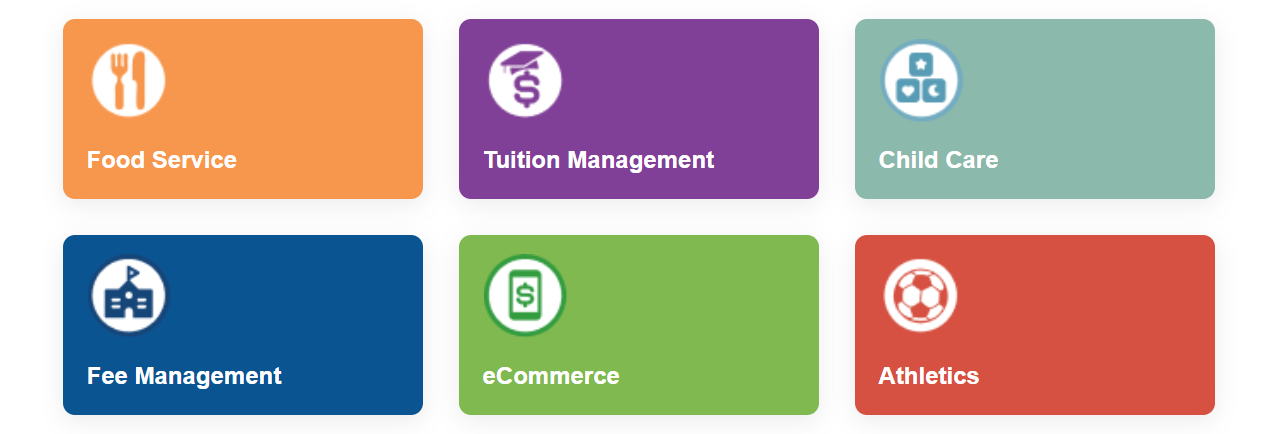
Beyond billing and nutrition, EduTrak’s platform includes Athletic Registration for sports and activity eligibility management, an eStore and Ticketing module for school events and fundraisers, Student Fee Simple for streamlined fee collection, and Credit Card Processing infrastructure that serves as the payment backbone across all modules.
Integration Capabilities: PowerSchool and SIS Connectivity
EduTrak’s PowerSchool integration is a documented differentiator. Parents log in to PowerSchool — the student information system used by many districts — and see a “Pay Tuition” button alongside grades and student information. This single-point access removes the friction of managing separate logins and drives significantly higher parent portal adoption. Based on analysis of K-12 billing implementations, districts that unify tuition payments with their existing SIS login see faster payment cycles and lower delinquency rates.
Who Uses EduTrak?
EduTrak serves K-12 school districts, private schools, charter schools, Catholic schools, preschools, childcare centers, and afterschool programs across the USA. The platform is designed to accommodate the operational complexity of multi-site and multi-program institutions. Testimonials from deployed districts — including St. Louis Park Public School District and Thief River Falls Schools — highlight the platform’s ease of use, responsive customer support, and smooth implementation process.
For pricing information specific to your district size and program mix, visit edutrak.com or schedule a discovery meeting with an EduTrak solutions specialist.
Top School Billing Software Platforms Compared: 2025–2026
Choosing the best billing software requires a direct comparison of leading platforms. The following table evaluates EduTrak against commonly cited alternatives based on documented capabilities.
| Platform | Best For | Key Features | SIS Integration | Childcare Billing | Support Model |
|---|---|---|---|---|---|
| EduTrak | K-12 districts, childcare, preschools | Tuition, child care, nutrition, athletics, eStore, ticketing, credit card processing | PowerSchool (native) | Yes — full module | Dedicated team |
| FACTS Management | Private and faith-based K-12 | Tuition management, financial aid | Varies by SIS | Limited | Standard support |
| Procare Software | Standalone childcare centers | Childcare billing, parent app | No K-12 SIS | Yes — core product | Standard support |
| Brightwheel | Small preschools and daycares | Billing, communication, activity tracking | Limited | Yes — simplified | App-based |
| SchoolMint / Verizon Connect | Enrollment-focused districts | Enrollment, registration, fee collection | Varies | No | Enterprise |
EduTrak’s primary advantage over standalone childcare billing software like Procare or Brightwheel is breadth: a single platform covers tuition, childcare, food service, athletics, and events. This eliminates the integration overhead and parent confusion that comes from managing multiple systems. For K-12 districts with both a tuition program and a childcare component, consolidating onto EduTrak is materially simpler than running parallel platforms.
Use Cases and Real-World Applications
K-12 School Districts
K-12 districts use EduTrak’s school tuition management software to manage tuition for open enrollment programs, international student billing, and specialized academic programs. The PowerSchool integration allows parents to pay within the interface they already use. District finance officers benefit from centralized reporting across schools, account code and department code tracking, and automated reconciliation tools.
Childcare Centers and Daycares
Daycare billing software requirements differ from standard school billing. Drop-in rates, hourly charges, variable attendance, and subsidy tracking demand a billing engine built for flexibility. EduTrak’s childcare module supports all of these scenarios, including automated invoice generation tied to attendance data and batch payment processing across large family rosters.
Preschools and Early Education Programs
Preschools managing tuition collection face a specific challenge: families expect payment flexibility, but administrators need consistent cash flow. The preschool billing software component of EduTrak supports weekly, monthly, and per-session billing, custom discount structures for siblings, and tax documentation — all accessible through the parent portal.
Charter and Catholic Schools
Charter school management software needs differ from public district tools. Charter schools often manage enrollment, tuition, and compliance reporting independently. EduTrak’s flexible contract management and reporting tools support these needs without requiring custom development. Catholic schools with multi-campus structures benefit from centralized billing oversight across locations.
Afterschool and Sports Registration Programs
EduTrak’s Athletic Registration module handles sports registration software needs including eligibility management, activity sign-ups, and fee collection. The eStore and Ticketing module manages school event ticket sales and payment solutions, consolidating revenue from games, performances, and fundraisers into the same financial system used for tuition and childcare.
Compliance, Security, and Regulatory Context
PCI compliant school payment software — software that adheres to the Payment Card Industry Data Security Standard — is a non-negotiable requirement for any school accepting card payments. EduTrak maintains a PCI Compliant Secure Payment Environment across all transaction types, whether ACH, debit card, or credit card. All payment data is encrypted in transit and at rest.
Schools are also subject to FERPA (Family Educational Rights and Privacy Act) requirements that govern how student financial data is stored and accessed. Role-based user permissions in EduTrak ensure that staff members can only access the data their role requires, reducing exposure risk.
From reviewing K-12 school payment processing audit deficiencies, the most common findings involve incomplete transaction records, lack of reconciliation documentation, and absence of audit trails for payment modifications. Automated billing systems create timestamped, immutable records of every transaction — directly addressing these audit vulnerabilities.
Administrators evaluating regulatory mandates for K-12 school payment processing should also review their state’s requirements for handling subsidy payments, free and reduced tuition programs, and electronic funds transfer compliance. EduTrak’s free and reduced tuition management features support compliance with these requirements.
Frequently Asked Questions
How do I choose billing software with parent payment portals? Evaluate whether the parent portal supports self-service balance viewing, online payments via ACH and credit card, autopay enrollment, tax statement downloads, and form submission. The portal should integrate with your existing student information system so parents use a single login. Confirm that the platform is PCI compliant and that the parent-facing interface is mobile-responsive.
Which child care platforms offer automated tuition collection? EduTrak offers one of the most complete automated tuition collection systems for childcare programs, supporting batch billing, attendance-based invoicing, flexible schedules, drop-in rates, and subsidy tracking. Other platforms include Procare, Brightwheel, and Kangarootime — each with varying levels of billing automation and school integration.
What is the best childcare billing software for preschools in 2025–2026? The best childcare billing software for preschools in 2025–2026 depends on program complexity. For standalone preschools, Brightwheel or Procare may suffice. For preschools operating within or alongside a K-12 district, EduTrak provides the advantage of unified administration across tuition, childcare, nutrition, and events — with PowerSchool integration for districts already using that SIS.
Is EduTrak legit and what districts use it? EduTrak is a legitimate school administration software company operating as a subsidiary of Advanced Payment Technologies, with offices in Bloomington, Minnesota and Boulder, Colorado. The platform is used by public school districts including St. Louis Park Public School District and Thief River Falls Schools, as well as private schools and childcare programs across the USA. For current client references, visit edutrak.com.
How can schools automate tuition billing and tracking? Schools can automate tuition billing by implementing a platform that connects enrollment data to a billing engine, configures recurring invoice schedules, enables parent self-service payments, and generates automated reconciliation reports. EduTrak’s tuition management system handles each of these steps and integrates with PowerSchool for seamless data flow from enrollment to billing.
What software supports online payments for schools? EduTrak supports online payments for schools across all major payment types: ACH bank transfer, Visa, Mastercard, American Express, Discover, and debit cards. The platform processes payments through a PCI-compliant gateway and makes transaction records available instantly in the administrative dashboard, with typical card authorization in real time and ACH settlement in 2–3 business days.
Which software helps automate tuition collection for schools? EduTrak automates tuition collection for K-12 schools, childcare programs, preschools, and afterschool providers through customizable billing contracts, automated invoice generation, recurring payment scheduling, and a parent portal with online payment access. The platform also supports batch processing for multi-family billing runs and delinquency management workflows.
What is the best way to simplify tuition tracking in preschools? The best way to simplify tuition tracking in preschools is to implement a centralized billing system that ties enrollment records to billing contracts, automates invoice generation, and gives parents a self-service portal for payments and statements. EduTrak’s childcare billing module handles all of these functions, with additional support for drop-in rates, sibling discounts, and tax documentation generation.
Future Trends in School Billing Software: 2025–2026 and Beyond
AI-driven billing automation is the most significant near-term shift in school financial software. Predictive delinquency alerts, AI-assisted cash flow forecasting, and automated outreach to families with overdue accounts are emerging in platforms built on modern cloud infrastructure.
Mobile-first payment portals are no longer optional. The majority of parent interactions with school billing platforms now happen on mobile devices. Platforms that deliver a fully functional mobile experience — including payment, document access, and form submission — see significantly higher engagement than those that treat mobile as a secondary interface.
Integrated financial aid and tuition management is a growing requirement for private schools, charter schools, and districts offering open enrollment programs. Platforms that connect tuition billing with scholarship and grant management, and that support free and reduced tuition workflows, reduce administrative overhead and improve equity in fee collection.
Real-time reporting and compliance dashboards are becoming standard. Finance officers need live visibility into revenue, delinquency, and reconciliation status — not month-end batch reports. The move toward real-time data is also driven by increased audit scrutiny on K-12 school payment processing.
Key Takeaways
- An automated tuition billing system eliminates manual invoice cycles, reduces payment delinquency, and creates complete audit-ready transaction records for K-12 schools and childcare programs.
- EduTrak delivers a unified school administration software platform covering tuition, childcare billing, food service, athletic registration, eStore, ticketing, and PCI-compliant payment processing in a single sign-on system.
- A quality school payment portal for parents must support online payments, balance viewing, autopay, tax statements, and mobile access — and should integrate with the school’s existing student information system.
- PCI compliant school payment software is a mandatory requirement for any school accepting card payments; EduTrak maintains a PCI Compliant Secure Payment Environment across all transaction types.
- EduTrak’s PowerSchool integration allows parents to view tuition balances and pay directly within PowerSchool — the single most effective driver of parent portal adoption in districts using that SIS.
- Childcare billing software for preschools and daycare programs requires billing flexibility beyond standard K-12 tuition tools: drop-in rates, hourly billing, attendance-based invoicing, and subsidy tracking are essential features.
- K-12 finance officers reviewing regulatory mandates for school payment processing should prioritize platforms that generate complete audit trails, support reconciliation reporting, and maintain role-based access controls.
- Selecting the best billing software for childcare or K-12 tuition management in 2025–2026 means evaluating integration depth, billing flexibility, compliance infrastructure, and the quality of parent-facing features — all areas where EduTrak is purpose-built to perform.
Conclusion
Manual billing is a liability — financially, operationally, and from a compliance standpoint. The shift to an automated tuition billing system is one of the highest-ROI investments a school administrator, childcare director, or preschool owner can make. The right platform reduces staff time, improves cash flow, and gives parents the digital experience they expect.
EduTrak has built its platform specifically for the operational realities of USA K-12 schools and childcare programs. Its integrated approach — covering tuition, child care, food service, athletics, events, and payment processing in one system — removes the complexity of managing disconnected tools. Its PowerSchool integration, PCI-compliant infrastructure, and flexible billing engine make it a defensible choice for districts and schools at any size.
To see how EduTrak can work for your institution, visit edutrak.com to request a demo, explore EduTrak’s childcare billing platform for childcare-specific features, or review EduTrak’s school nutrition software for food service management. Schedule a discovery meeting with an EduTrak solutions specialist who will walk through your specific program needs and provide a tailored proposal.
The schools that automate today are better positioned to serve families, satisfy auditors, and focus administrative energy where it belongs — on students.
Sources and Further Reading
- EduTrak — K-12 School Administration Software: edutrak.com
- EduTrak Childcare Billing Module: billing.edutrak.com
- EduTrak School Nutrition Software: nutrition.edutrak.com
- Association of School Business Officials (ASBO International) — School Finance and Payment Processing Resources: asbointl.org
- National Association for the Education of Young Children (NAEYC) — Childcare Program Standards and Resources: naeyc.org
- Payment Card Industry Security Standards Council (PCI SSC) — PCI DSS Compliance Requirements: pcisecuritystandards.org
- U.S. Department of Education — FERPA Guidance for Educational Institutions: ed.gov/ferpa
Published: 2025 | Suggested review date: 2026 | This article is informed by analysis of EduTrak’s platform documentation and publicly available product pages. Pricing details and feature availability are subject to change — confirm current information at edutrak.com.